A kitchen timer is a simple but essential tool for cooking and baking accurately. Understanding the different types and what to look for helps you choose one that fits how you actually cook.
Why a Dedicated Kitchen Timer
Most smartphones have a built-in timer, and it works. But a dedicated kitchen timer has specific advantages: you can read it at a glance from across the kitchen; it is always in the kitchen rather than wherever your phone happens to be; a physical timer is faster to set for quick tasks; and in a professional or busy home kitchen, a timer that sits visibly on the counter is less likely to be missed than a phone notification.
Types of Kitchen Timers
Mechanical (Wind-Up) Timer
The original kitchen timer — a spring mechanism wound to a set time that rings a bell when the spring unwinds. No batteries required. Simple to use. The main limitation is that mechanical timers are less accurate (typically +/- 1-2 minutes) and the bell sound is not as loud as an electronic alarm. The classic round shape is easy to use without looking at it.
Digital Timer (Single)
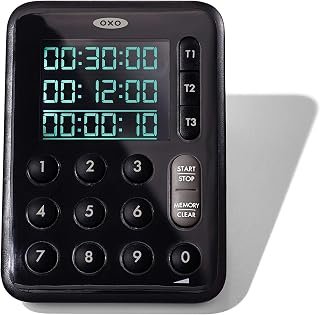
An electronic timer with a display and buttons. More accurate than mechanical. Typically includes count-up and count-down modes. Loud electronic alarm. Can be reset immediately for the next task. Magnetic backing for attachment to the refrigerator. The OXO Good Grips digital timer is a frequently recommended model for its clear display and loud alarm.
Multi-Channel Timer
A digital timer that runs multiple simultaneous timers independently. Essential for complex cooking where multiple dishes with different cook times are running at the same time. Professional kitchen timers often have 4-8 channels. For home cooks who prepare multi-component meals, a dual or triple channel timer eliminates the need to use the phone as a secondary timer.
Smart/App-Connected Timer
Connects to a smartphone app. Useful for tracking temperature alongside time (when connected to a thermometer) or for receiving alerts when away from the kitchen. More complexity than most home cooks need for straightforward timing tasks.
Key Features
Alarm Loudness
The alarm must be loud enough to hear from another room. Some timers have adjustable volume or a progressive alarm that gets louder. If you are in the habit of stepping away from the kitchen while something cooks, a loud alarm is non-negotiable.
Ease of Setting
A timer that takes 10 button presses to set a simple 10-minute countdown is frustrating during a busy cooking session. Dial controls are faster than button-by-button entry for most settings. A single button that adds minutes quickly is better than having to cycle through digits.
Display Readability
Large, high-contrast digits that can be read from 2-3 meters away allow you to check the timer without crossing the kitchen every time.
Magnetic Backing and Clip
A strong magnetic backing allows the timer to attach to the refrigerator or oven side — keeping it visible and out of the way at the same time. A clip option provides additional attachment flexibility.
What to Look For
For most home cooks, a single-channel digital timer with a loud alarm, clear large display, and magnetic backing covers all everyday needs. For multi-component cooking, a dual or triple channel timer eliminates the need for workarounds. OXO Good Grips and ThermoPro both make reliable kitchen timers in this category.
Summary
A kitchen timer is a deceptively important tool that directly affects cooking accuracy. Alarm loudness, ease of setting, display readability, and the number of simultaneous channels are the key factors. A quality timer is a small investment with a daily impact on cooking results.
You can check more details and current options on Amazon here.